
Yacht
Brokerage
Refined
Strategic guidance for buyers and sellers who expect more.
View All Listings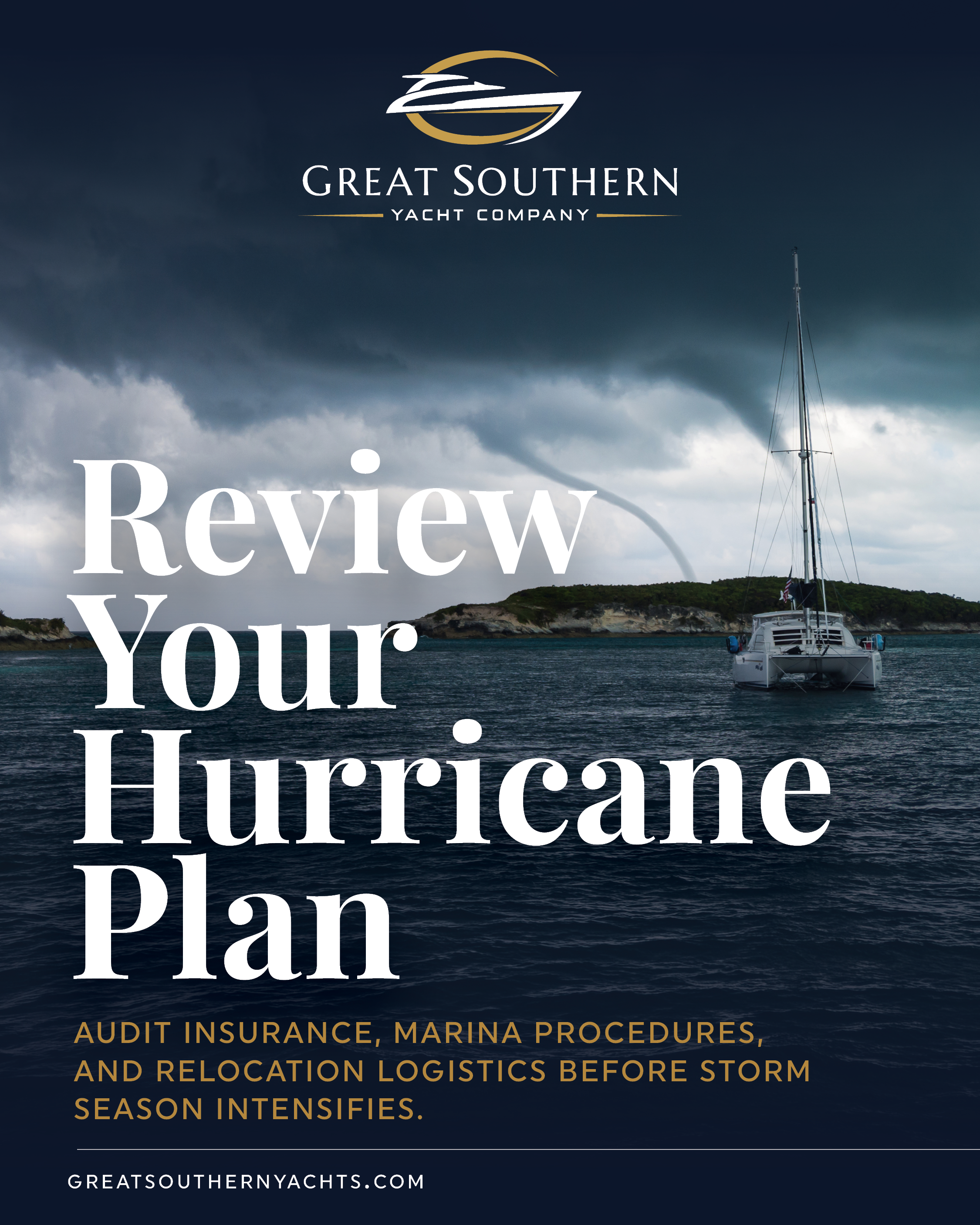
If your plan hasn’t been updated since last season, schedule a quick hurricane-readiness review with a fiduciary yacht broker to audit insurance alignment, marina procedures, and relocation logistics now
Hurricane Season and Your Yacht: Why Last Year’s Plan May Not Be Enough
Along the Emerald Coast and in South Florida, hurricane planning is part of responsible yacht ownership. Yet many owners quietly reuse the same plan year after year. Insurance is auto-renewed, marina agreements roll over, and last season’s storm checklist is pulled out of the same folder.
The risk isn’t that you lack a plan; it’s that your plan may no longer match your actual risk, your boat’s current value, or how your insurance, marina, and logistics providers operate today.
If your hurricane plan hasn’t been updated since last season, this is the time to step back and conduct a hurricane-readiness review with a fiduciary yacht broker who understands both the local waters and national best practices.
Why Hurricane Plans Need an Annual Checkup
Storm patterns, marina policies, and market conditions change. So do your vessels, cruising habits, and personal tolerance for risk. A plan that made sense two or three years ago can quietly become outdated.
Key reasons to review annually:
- Insurance policies evolve – Deductibles, named-storm clauses, and haul-out credits can change at renewal.
- Marinas adjust procedures – Evacuation requirements, proof-of-plan documentation, and wind thresholds may be updated each season.
- Yacht values move with the market – If your insured value hasn’t been revisited, you may be overpaying or underinsured.
- Your cruising footprint shifts – Spending more time in South Florida than on 30A? That changes storm exposure and logistics.
- Vendor capacity is limited – Haul-out yards, captains, and transport providers book up quickly once a storm is named.
A short review with an experienced Destin or 30A yacht broker is often enough to surface misalignments before they become problems in the cone of uncertainty.
Start With Insurance: Does Your Coverage Match Today’s Reality?
A hurricane-readiness audit should begin with the policy itself. A fiduciary yacht broker can help you interpret the fine print in the context of real-world storm events along the Gulf Coast and Atlantic.
Clarify the following:
1. Named Storm and Windstorm Coverage
- Are named-storm damages covered under the same terms as other losses?
- Is there a separate named-storm deductible, and how is it calculated (flat amount vs. percentage of hull value)?
- Are there geographic restrictions (e.g., lay-up north of a certain latitude by a specified date)?
2. Haul-Out and Relocation Provisions
Many policies along Florida’s Emerald Coast and in South Florida now offer:
- Haul-out reimbursement when a storm watch or warning is issued.
- Relocation or captain’s fees to move the yacht to a safer marina or hurricane hole.
Confirm:
- What triggers those benefits (watch, warning, or named storm within a set radius)?
- Which yards or facilities qualify?
- What documentation you must provide after the event.
3. Current Agreed Value vs. Market Reality
As a firm focused on pre-owned yacht brokerage, we see values move up and down with:
- Builder demand
- Age, refit history, and engine hours
- Regional inventory (Destin vs. Fort Lauderdale vs. national market)
A fiduciary broker can benchmark your vessel’s current market range so you can discuss appropriate hull values with your insurance professional, especially if:
- You completed a meaningful refit or repower
- You added high-value electronics or a tender
- The market for your size and type of yacht has shifted significantly
Marina Procedures: Don’t Assume Last Year’s Rules Still Apply
Many owners rely heavily on their marina to guide hurricane preparation. That trust is well placed—but only if you clearly understand the current rules and your responsibilities.
Ask your marina (or marinas, if you have multiple slips):
-
Evacuation policy
- At what forecast wind speed or surge level must vessels vacate?
- Are certain docks or sizes prioritized for haul-out or relocation?
-
Owner vs. marina duties
- Who removes canvas, enclosures, and loose deck items?
- Does the marina double lines or is that entirely owner- or captain-managed?
-
Proof of plan
- Do they require a written hurricane plan on file?
- Are there preferred vendors for haul-out or transport?
A fiduciary yacht broker who routinely manages marina placement and slippage for clients can help you compare options between Destin, Sandestin, Miramar Beach, 30A, and South Florida, and identify facilities with policies that match your expectations.
Relocation Logistics: The Part Most Owners Underestimate
When a storm approaches, time compresses. The difference between a smooth relocation and a scramble usually comes down to what was arranged weeks or months in advance.
Consider these elements in your hurricane-readiness review:
1. Who Actually Moves the Boat?
- Do you have a designated captain or crew on standby if you’re out of town?
- Are they familiar with your electronics, ground tackle, and systems?
- Do they know your preferred hurricane slip, haul-out yard, or inland route?
2. Where Will the Yacht Go?
Depending on draft, bridge clearance, and size, options may include:
- Haul-out at a local yard
- Relocation to a more protected marina or basin
- Short-distance repositioning within your current marina
A broker with USCG Master Captain experience can help you vet realistic relocation destinations based on your yacht’s characteristics and the local geography.
3. Overland or Long-Distance Transport
For larger vessels—especially those purchased through a national search—your hurricane strategy may involve:
- Professional transport to a different region ahead of peak season
- Seasonal repositioning between the Emerald Coast and South Florida
- Coordination of pilots, permits, and delivery crews
These decisions are best made well before hurricane season, not while tracking a storm.
The Value of a Fiduciary Yacht Broker in Hurricane Planning
A fiduciary yacht broker operates as a private consultant, not a sales intermediary. Because firms like Great Southern Yacht Company do not represent manufacturers or carry new inventory, the advice you receive is not influenced by brand, inventory, or commission-driven priorities.
In a hurricane-readiness review, a fiduciary broker will:
- Audit your plan for practical gaps in insurance alignment, marina procedures, and logistics.
- Incorporate real-world experience from surveys, sea trials, and cross-country deliveries in similar conditions and markets.
- Coordinate with your existing team—insurers, captains, marinas—to keep everyone aligned.
- Document a clear, step-by-step plan for what happens at the watch, warning, and landfall stages.
The goal is not simply to protect the asset, but to reduce uncertainty for you and your family when the forecast becomes personal.
When to Schedule Your Hurricane-Readiness Review
If your plan hasn’t been updated since last season—or if you’ve:
- Purchased or sold a yacht
- Changed marinas or slips
- Modified your cruising range
- Completed a refit or major upgrade
…it’s time to revisit your hurricane strategy.
A focused review with an experienced Florida yacht brokerage usually takes less than an afternoon and can prevent rushed decisions in the days before a storm.
If you own or are planning to buy or sell a yacht along Florida’s Emerald Coast, South Florida, or elsewhere nationwide, Great Southern Yacht Company is available to serve as your private hurricane-readiness partner. Contact our team to schedule a confidential plan review and ensure your yacht, your coverage, and your logistics are aligned for the season ahead.