
Yacht
Brokerage
Refined
Strategic guidance for buyers and sellers who expect more.
View All Listings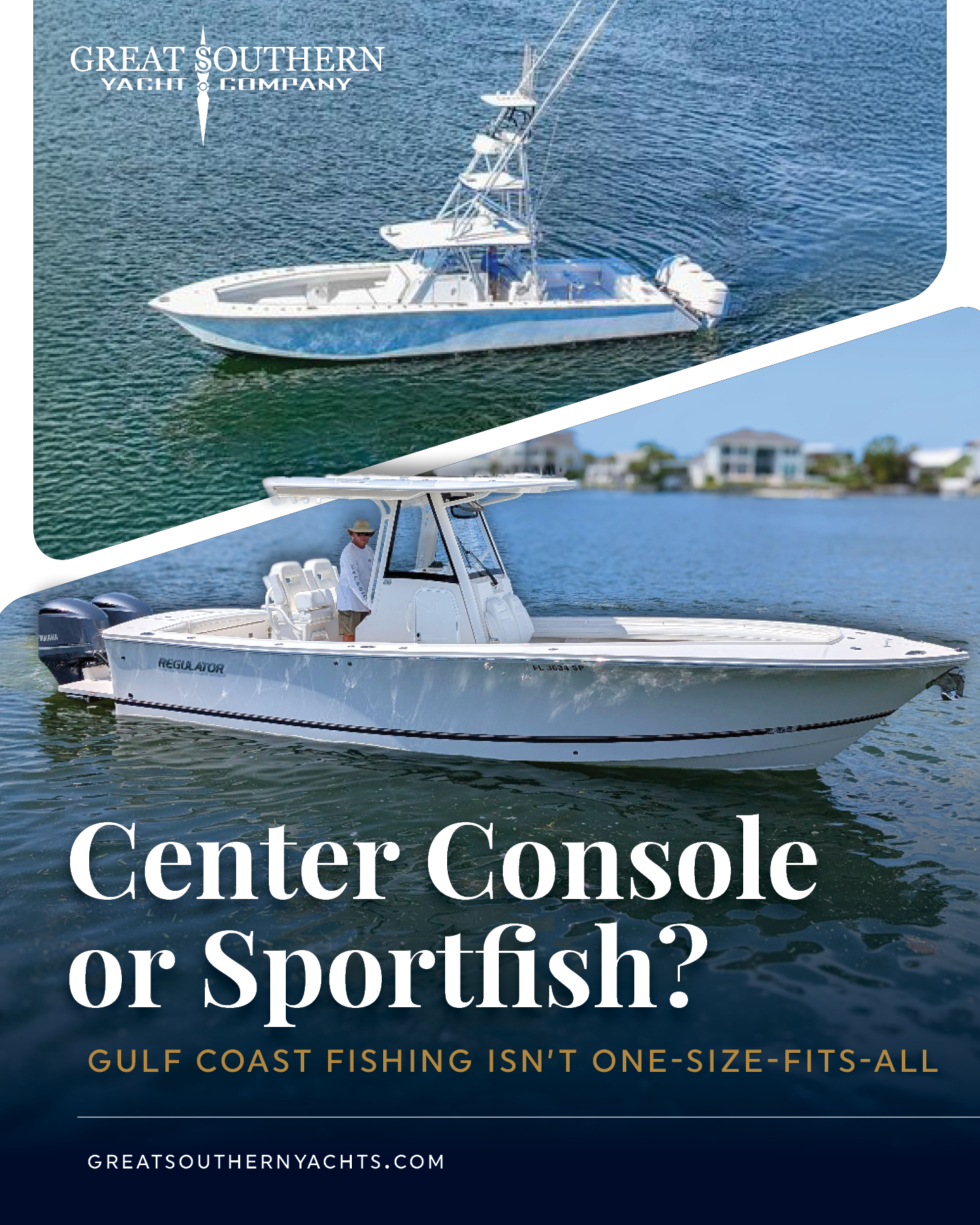
Center console or sportfishing yacht for Gulf Coast use: how a captain-broker evaluates range, livewell systems, and fishability versus maintenance reality to guide the right call. Learn more at our site
Center console or sportfishing yacht for the Gulf Coast? A captain-broker’s checklist for range, livewells, fishability, and maintenance
Choosing between a center console and a sportfishing yacht along Florida’s Emerald Coast and the broader Gulf isn’t about hype—it’s about mission, conditions, and ownership realities. As captain-brokers working every day from Destin and 30A to South Florida, we evaluate how you fish, how far you run, and how much system complexity you want to maintain. Here’s how we guide clients to the right call.
Start with your mission and water
The Gulf demands different choices than the Atlantic. Runs to the DeSoto Canyon, floaters, and rigs can stretch 80–150+ nautical miles offshore with narrow weather windows and summer heat. Nearshore snapper, kingfish, and cobia along the beach require speed, agility, and sight lines. Define:
- Typical range: 20–50 nm day trips vs 100–200 nm offshore missions
- Crew and family comfort needs: shade, seating, air conditioning, enclosed helm
- Overnighting: need for berths, generator, galley, and full systems
- Storage and slip reality: rack storage vs wet slip and shore power access along Destin, Sandestin, Miramar Beach, and 30A
Range and endurance: the Gulf math
A captain-broker calculates usable range, not brochure range. We plan with a 20–30% reserve and factor sea state, load, and current.
- Center consoles (triple/quad outboards): Fast and efficient at cruise, often 300–400 nm usable range depending on tankage and setup. Ideal for quick strikes and tight weather windows.
- Sportfishing yachts (inboard diesel): Larger fuel capacity and better endurance at displacement or semi-planing speeds; 500–800+ nm usable range is common, with stability advantages on long runs.
For Gulf-specific tuna and sword trips, we look at fuel burn at your real cruise RPM, not WOT numbers, and model your plan with realistic reserves for detours and extended drifts.
Livewell systems: bait programs drive plumbing choices
Gulf anglers rely on live baits—pilchards, threadfin, menhaden, blue runners. Summer water temps demand flow and oxygen.
What we evaluate on survey and sea trial:
- Flow and redundancy: Dedicated sea chests, high-capacity pumps, and backup pumps on independent circuits
- Plumbing design: Large-diameter pickup and returns, rounded wells to prevent bait stacking, slosh control and lids
- Oxygenation and cooling: Consider oxygen infusion and insulation for summer heat
- Access and service: Seacock location, strainer access, and ease of pump replacement offshore
Center consoles can be excellent if outfitted with proper sea chests and dual pumps. Sportfishing yachts often add transom and deck wells tied into robust sea systems—more capacity and redundancy, but also more maintenance.
Fishability in Gulf conditions
-
Center console advantages:
- 360-degree fishability for cobia on the beach, kingfish, and nearshore run-and-gun
- Shallow draft for bays and passes, quick acceleration, and easier trailerability
- Towers with clear sight lines for sight-fishing along 30A and Destin beaches
-
Sportfishing yacht advantages:
- Large cockpits with mezzanine seating, rigging stations, tackle centers, and tuna doors
- Enclosed helm and salon comfort for long runs, summer thunderstorms, and winter fronts
- Better backing-down and drift behavior for big-game and kites, plus superior fish boxes and ice capacity
We also test drift stability, cockpit workflow with a full crew, and how the boat handles inlets and short-period Gulf chop.
Maintenance reality: systems, service, and downtime
The right boat is the one you can confidently maintain. We model total cost of ownership and downtime, not just purchase price.
-
Outboard center consoles:
- Service every 100 hours; multi-engine rigs multiply parts and labor
- Repower cycles often 1,500–2,000 hours; plan for a future capital event
- Corrosion vigilance in brackish bays; simple systems mean fewer onboard failures
- Dry stack and trailer options reduce bottom paint and running-gear work
-
Inboard sportfishing yachts:
- Annual diesel services, aftercooler intervals, generator maintenance, air conditioning, watermakers, and gyrostabilizers
- Bottom paint, running gear, and periodic yard time for shafts, seals, and alignment
- More reliable heavy-weather capability but more systems to monitor and budget for
We compare insurance requirements, hurricane plans, haul-out access, and parts availability—practical issues that decide whether you’ll be fishing or waiting on a yard slot in peak season.
Slips, shore power, and Gulf Coast logistics
Marina and slippage availability from Destin to South Walton can be tight, and power needs vary:
- Center consoles: Rack storage is common; verify height with towers/T-tops, forklift limits, and livewell water feed rules
- Sportfishing yachts: Confirm beam, draft, shore power (50A/100A), and hurricane tie-down capabilities; check bridge/tower clearances for transits
As a Florida yacht brokerage with national reach, we secure slips, arrange delivery crews, and coordinate transport or cross-country moves when a better vessel is found outside the region.
Sea trials and surveys that reflect real use
Our IYBA-member and USCG-licensed brokers run disciplined tests:
- Ride and noise at your actual cruise; gyro on/off if equipped
- Bait survival in livewells over hours, not minutes
- Drift and troll behavior; backing down and cockpit safety
- Helm ergonomics, shade, and visibility from towers
- Heat load vs generator capacity; bilge access and serviceability
- Fuel flow data collection and reserve calculations
Post-survey, we provide a clear maintenance roadmap and negotiate findings with a client-first posture.
When each is usually the right call
Choose a center console if you value:
- Speed, simplicity, and 360-degree fishability
- Nearshore and midrange runs with flexible weather windows
- Rack storage or trailerability, lower systems complexity, and easier upkeep
Choose a sportfishing yacht if you need:
- Range and comfort for canyon, rig, and overnight fisheries
- Enclosed, climate-controlled space for crew and family
- Big-game capability, large bait and ice capacity, and stable bluewater performance
A fiduciary, brand-agnostic approach
As private yacht consultants, we don’t carry new inventory or push manufacturers. Whether you’re searching “Destin yacht broker,” “30A yacht broker,” “buy a yacht Florida,” or planning to “sell my yacht,” our role is clarity: everything known, everything discoverable, and everything experience suggests. We source nationwide, manage showings, surveys, sea trials, contract-to-close, and marina placement—then stay involved for the long haul.
Ready to evaluate your mission and shortlist the right boats? Contact Great Southern Yacht Company for a private, captain-led consultation. Learn more at our site.