
Yacht
Brokerage
Refined
Strategic guidance for buyers and sellers who expect more.
View All Listings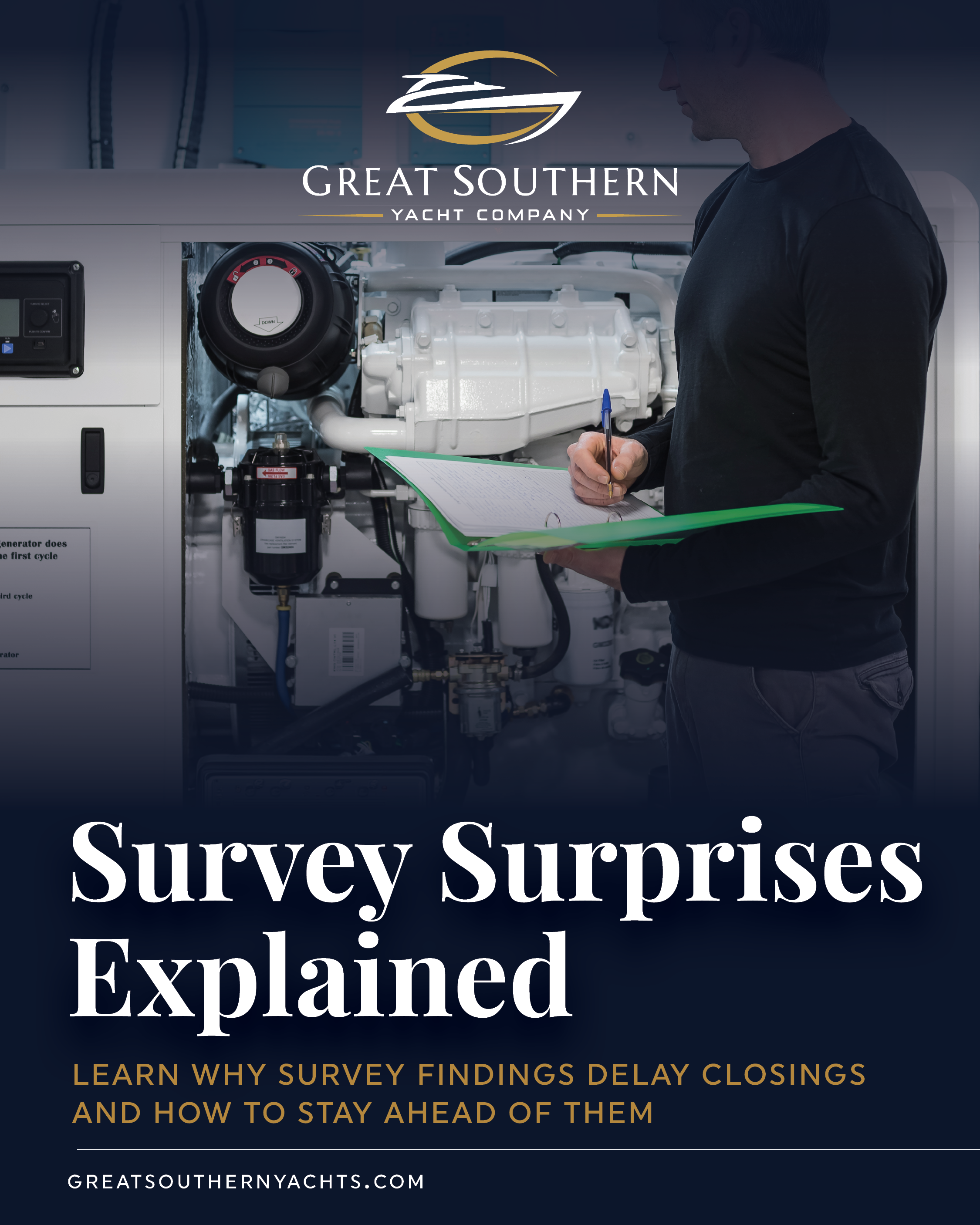
The overlooked reason survey results derail closings, and steps to prevent costly surprises
The Overlooked Reason Survey Results Derail Closings — And How To Prevent Costly Surprises
When a yacht deal falls apart after the survey, buyers and sellers often blame “bad news” on the report: moisture readings, engine findings, corrosion, or outdated systems. In reality, those issues are common and often manageable.
The real, overlooked reason survey results derail closings is misaligned expectations.
When buyers, sellers, and sometimes even brokers walk into a survey without a shared understanding of:
- What the survey is (and is not) designed to do
- What’s normal for that age, size, and class of yacht
- How findings will likely impact value, insurance, and safety
…then even predictable findings feel like “deal-killers.”
A well-run survey on a pre-owned yacht should refine the deal, not destroy it. The difference comes down to preparation, communication, and disciplined representation.
Below are practical steps our team at Great Southern Yacht Company uses to prevent costly surprises for yacht buyers and sellers along Florida’s Emerald Coast, South Florida, and nationwide.
Why Surveys Become Flashpoints in Yacht Deals
Most survey-driven collapses share a few common patterns:
1. No Shared Baseline for “Normal”
A 20-year-old sportfish in Destin and a late-model cruising yacht in South Florida will have very different “normal” findings. If a buyer expects a used yacht to survey like a new build, or a seller expects a clean bill of health on an older vessel, tension is inevitable.
Common examples:
- Elevated moisture in deck hardware areas on older boats
- Cosmetic gelcoat spider cracking
- Non-original wiring or modifications
- Deferred maintenance on generators or air conditioning
None of these automatically make a yacht unworthy. They do, however, require context and a plan.
2. Treating the Survey as a Negotiation Weapon
When parties approach the survey thinking, “We’ll use whatever we can to re-trade the deal,” trust erodes. Sellers feel ambushed. Buyers feel pressured. Every recommendation becomes a battleground rather than a data point.
3. Misunderstanding Survey Scope and Limits
A marine survey is:
- A snapshot in time
- Performed without destructive testing
- Focused on safety, structural integrity, and major systems
It is not:
- A comprehensive refit plan
- A guarantee that nothing will ever break
- A substitute for hands-on operational experience
When expectations go beyond what a survey can reasonably provide, disappointment follows.
Step 1: Start With a Reality-Based Pre-Survey Conversation
Before any offer is signed, your yacht broker should guide you through realistic expectations for the survey phase.
For buyers, that means:
- Discussing typical findings for the specific build, age, and use profile
- Reviewing known service history and any gaps in documentation
- Clarifying what would be considered a “walk-away” issue for you personally (e.g., major structural damage, significant engine trouble, title or documentation concerns)
For sellers, that means:
- Candidly reviewing the vessel’s condition, including deferred maintenance
- Discussing likely buyer concerns and insurance requirements
- Identifying items that are better addressed before listing versus disclosed and priced into the market
At Great Southern Yacht Company, our brokers routinely do informal “pre-survey” walk-throughs with clients, especially on higher-value yachts and megayachts. This allows us to flag probable findings and build them into expectations and pricing from the outset.
Step 2: Choose the Right Surveyors — And Understand Their Roles
Your survey is only as strong as the professionals involved.
A well-structured survey day may include:
- Hull and Systems Surveyor – Evaluates overall structure, safety, and onboard systems
- Engine/Mechanical Specialist – Factory-trained or experienced technicians for specific engines, pods, or generators
- Oil and Fluid Analysis – Helps detect abnormal wear or contamination
- Sea Trial – Confirms performance under real-world conditions
On more complex yachts, our team often coordinates multiple specialists and staggers timing so each can work effectively. As private yacht consultants, we help buyers and sellers understand what level of survey is appropriate for the vessel and transaction, whether it’s a 40-foot trawler in Miramar Beach or a 100-foot motor yacht in Fort Lauderdale.
Step 3: Anchor the Deal in Market Reality, Not Hope
Surveys derail closings when the price never matched the true condition of the yacht.
To avoid this:
-
For Sellers:
- Use objective market analysis for pricing, including comparable sales and current inventory
- Factor in age-appropriate wear and any known issues
- Decide, in advance, your flexibility if survey findings confirm work is needed
-
For Buyers:
- Assume you’re purchasing a used yacht that will require ongoing maintenance
- Understand how the asking price compares to similar boats with different condition profiles
- Budget for post-closing upgrades and catch-up maintenance, not just the purchase price
Because Great Southern Yacht Company is brand-agnostic and doesn’t carry new inventory, our only incentive is to price and negotiate in alignment with reality — not to protect a particular builder or listing.
Step 4: Prepare for Survey Day Like a Project, Not an Event
A well-prepared survey reduces surprises and keeps emotions in check.
We recommend:
-
Clear logistics
- Haul-out scheduled and confirmed
- Fuel and fluids at appropriate levels for a valid sea trial
- Keys, documentation, and access ready
-
Defined roles
- Broker acting as project manager and buffer, not as a cheerleader
- Surveyors given space to work and speak candidly
- Buyer and seller informed when it’s appropriate to be present, and when to step back
Our brokers routinely travel to be onsite for showings, surveys, and sea trials across Florida and nationwide, coordinating yard schedules, transport, and marina placement, so clients can focus on decisions rather than logistics.
Step 5: Interpret the Survey Professionally, Not Emotionally
The period after receiving survey and sea trial results is pivotal.
We walk clients through:
-
Classifying findings
- Safety-critical issues
- Insurance or underwriting concerns
- Short-term maintenance items
- Longer-term improvements and upgrades
-
Separating must-fix from nice-to-address
-
Estimating realistic cost ranges, not guesswork
This structured analysis turns a thick survey report into a clear action plan:
- Proceed as agreed
- Renegotiate price or repairs based on documented, material findings
- Walk away, if issues fundamentally change the risk profile
The key is alignment with what was discussed before the offer. When expectations and thresholds are set early, survey results refine the path instead of surprising everyone late in the process.
Step 6: Use Documentation and Transparency to Preserve Trust
Whether you are buying or selling:
- Put survey-related agreements in writing
- Ensure addendums, repair agreements, and adjustments are clearly documented
- Keep communication transparent and timely
Great Southern’s guiding principle is clarity: we tell clients everything we know, everything we can discover, and everything our experience suggests. That clarity is often the difference between a difficult but successful closing and a deal that falls apart for avoidable reasons.
Navigating Surveys With Confidence
Marine surveys are not the enemy of a successful closing. They are the tool that allows serious buyers and serious sellers to move forward with confidence.
When expectations are aligned, pricing reflects true condition, and a fiduciary-focused broker manages the process, survey results become a roadmap — not a roadblock.
If you’re considering buying or selling a yacht along Florida’s Emerald Coast, South Florida, or anywhere in the U.S., and want a survey and closing process grounded in clarity, transparency, and hands-on expertise, Great Southern Yacht Company is here to help. Reach out to speak with a broker about your next transaction.