
Yacht
Brokerage
Refined
Strategic guidance for buyers and sellers who expect more.
View All Listings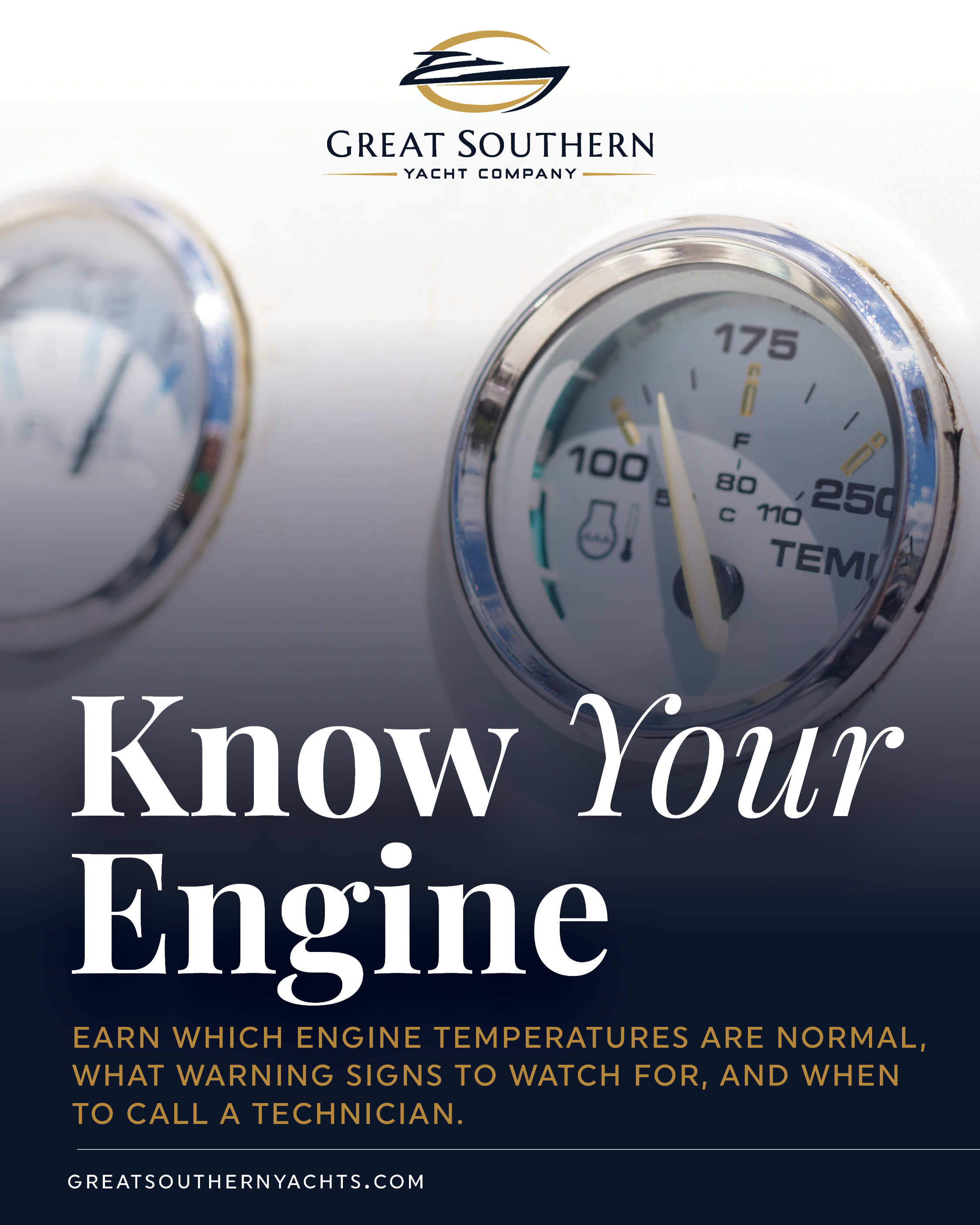
Beginner’s guide to reading your engine’s telltales in summer heat: normal vs
A Beginner’s Guide to Engine Telltales in Summer Heat
Summer on the Gulf or in South Florida is hard on both owners and engines. Water and air temperatures climb, marinas get busy, and cooling systems work much harder than they do in the shoulder seasons. For new yacht owners, learning to “read” your engine’s telltales is one of the most valuable habits you can build.
This guide outlines what’s normal versus concerning at cruise, what rising temps at idle can signal, how to log trends, and when it’s time to call a technician—not just for owners on the Emerald Coast, but for any boater operating in hot conditions.
Know Your Normal: Baseline Temperatures at Cruise
Every engine has its own “normal.” Before you can spot a problem, you need to know what healthy looks like for your specific setup.
Typical cruise temperatures
Always confirm with your engine manual or technician, but as a general range:
-
Modern diesel inboards
Often run around 180°F–195°F (82°C–90°C) at normal cruise load. -
Gasoline inboards / sterndrives
Often run around 160°F–180°F (71°C–82°C) depending on thermostat rating. -
Outboards
Frequently show lower temps, often 120°F–160°F (49°C–71°C), but check your manufacturer’s specs.
In summer, expect to see slightly higher numbers than you do in the spring or fall, particularly in:
- Destin, Sandestin, Miramar Beach, and 30A, where bay and Gulf water can be very warm
- South Florida, where high ambient temps and warm seawater are the norm
What matters most is consistency. A diesel that has lived at 188°F for years and now runs at 200°F at the same RPM and load is telling you something.
Red flags at cruise
You don’t need to panic at every degree of change, but these patterns warrant attention:
-
Steady upward creep at the same RPM and conditions
Example: Your normal is 185°F; over several outings you’re now at 195–200°F with no change in load. -
Uneven temps between engines
Twin diesels with a 5–10°F difference can be normal. A 15–20°F or larger split, particularly if it’s new, deserves investigation. -
Temp spikes when you push the throttles
Rising briefly then settling is one thing. Rising and staying elevated when you add power may indicate restricted cooling or overloading.
If your gauge crosses into the manufacturer’s caution or high-temp range at cruise, ease back on throttle, watch closely, and plan to have it checked.
What Rising Temps at Idle May Be Telling You
Many owners focus on cruise temperatures and overlook what happens at idle. In summer heat, rising temps at idle or slow no‑wake speeds can be an early warning.
Common causes of hotter idle temps
-
Restricted raw water flow
- Partially clogged sea strainer (grass, plastic bags, jellyfish in Gulf and Florida waters)
- Worn or damaged impeller
- Marine growth in intakes or heat exchangers
-
Heat-soaked engine room
- Poor ventilation when idling in tight marinas or waiting at bridges
- Fans/blowers not operating as designed
-
Idle set too low or cooling system marginal
- Engines turning fewer RPM than they should at idle, moving less water
- Cooling system that is dirty or scaled, leaving little margin in hot conditions
-
Summer fuel and loading changes
- Extra gear, full water tanks, and more guests, particularly on larger cruisers and motor yachts
- Generator running heavy loads, adding heat to the engine space
When idle temps are a concern
Pay attention if you see:
- Temps that climb steadily while idling in a no‑wake zone, then drop quickly as you increase speed
- One engine that runs noticeably hotter at idle than the other
- Temps that are fine underway but creep close to warning or alarm range when docking, waiting at a ramp, or maneuvering in tight marinas
Often, this points to marginal cooling capacity: the system can just keep up at speed but struggles when there’s less water flow and less natural airflow. That’s the time to intervene, not to wait for an overheat alarm.
How to Log Engine Trends Before They Become Repairs
The most experienced captains and yacht brokers pay close attention to engine data. You don’t need advanced systems to do the same; a simple log can help you catch issues early.
What to record on each outing
Build a basic engine log that includes:
-
Date, location, and conditions
(Emerald Coast bay run vs. Gulf run, South Florida ICW, sea state, air temp) -
RPM and speed
Typical cruise RPM and corresponding speed over ground -
Engine coolant/operating temps
Both engines, at idle, at cruise, and after long no‑wake stretches -
Oil pressure and voltage
Helps you see the full picture, not just temperature -
Load (if available digitally)
Percentage of engine load at given RPM on newer systems
You don’t need to log every 10 minutes. Capturing a few consistent data points:
- 5–10 minutes after leaving the dock
- Once you’re settled at cruise
- After extended no‑wake or idle
- At the end of the day, after docking
This will build a clear “normal” profile over time.
Simple tools for tracking
- A small waterproof notebook at the helm
- A spreadsheet on your tablet or laptop
- Photos of your gauge cluster at key moments
Patterns become obvious quickly: a slow drift from 185°F to 195°F over several weeks may not be noticeable day to day, but is clear when logged.
When to Call a Marine Technician
Not every temperature change is an emergency, but certain situations call for professional help rather than watchful waiting.
Call a technician promptly if you notice:
- Overheat alarms or rapid spikes in temperature at any speed
- Temperature climbing at idle that doesn’t recover quickly when you get underway
- A new, persistent 15–20°F difference between twin engines at the same RPM and conditions
- Visible coolant leaks, low coolant levels, or repeated need to top up
- Discolored coolant, milky oil, or steam from the exhaust combined with elevated temps
In warm Gulf and South Florida waters, technicians routinely see:
- Scale and marine growth in heat exchangers
- Partially blocked aftercoolers or oil coolers
- Impellers that appear “ok” from a distance but are missing vanes
- Exhaust elbows and mixing components restricted by corrosion
Early intervention is almost always less expensive than running a hot engine until it fails.
How a Trusted Yacht Broker Can Help
A knowledgeable Florida yacht brokerage or Destin yacht broker doesn’t just help you buy or sell a vessel—they also help you understand what you’re buying.
At Great Southern Yacht Company, our brokers:
- Review engine logs and maintenance history during the purchase process
- Coordinate surveys, sea trials, and technician inspections nationwide
- Help you interpret temperature behavior and other telltales during sea trials
- Advise on marina and slippage choices that support proper cooling and access to quality service
- Connect you with reputable marine technicians along the Emerald Coast, South Florida, and beyond
If you’re considering a yacht purchase, preparing to sell, or simply want an informed second set of eyes on how your engines are running, our team is here as a long-term resource.
Thinking about buying or selling a yacht, or want a more technical eye on your current vessel’s performance? Contact Great Southern Yacht Company to speak with a broker who combines real-world boating experience with fiduciary-first yacht consulting.