
Yacht
Brokerage
Refined
Strategic guidance for buyers and sellers who expect more.
View All Listings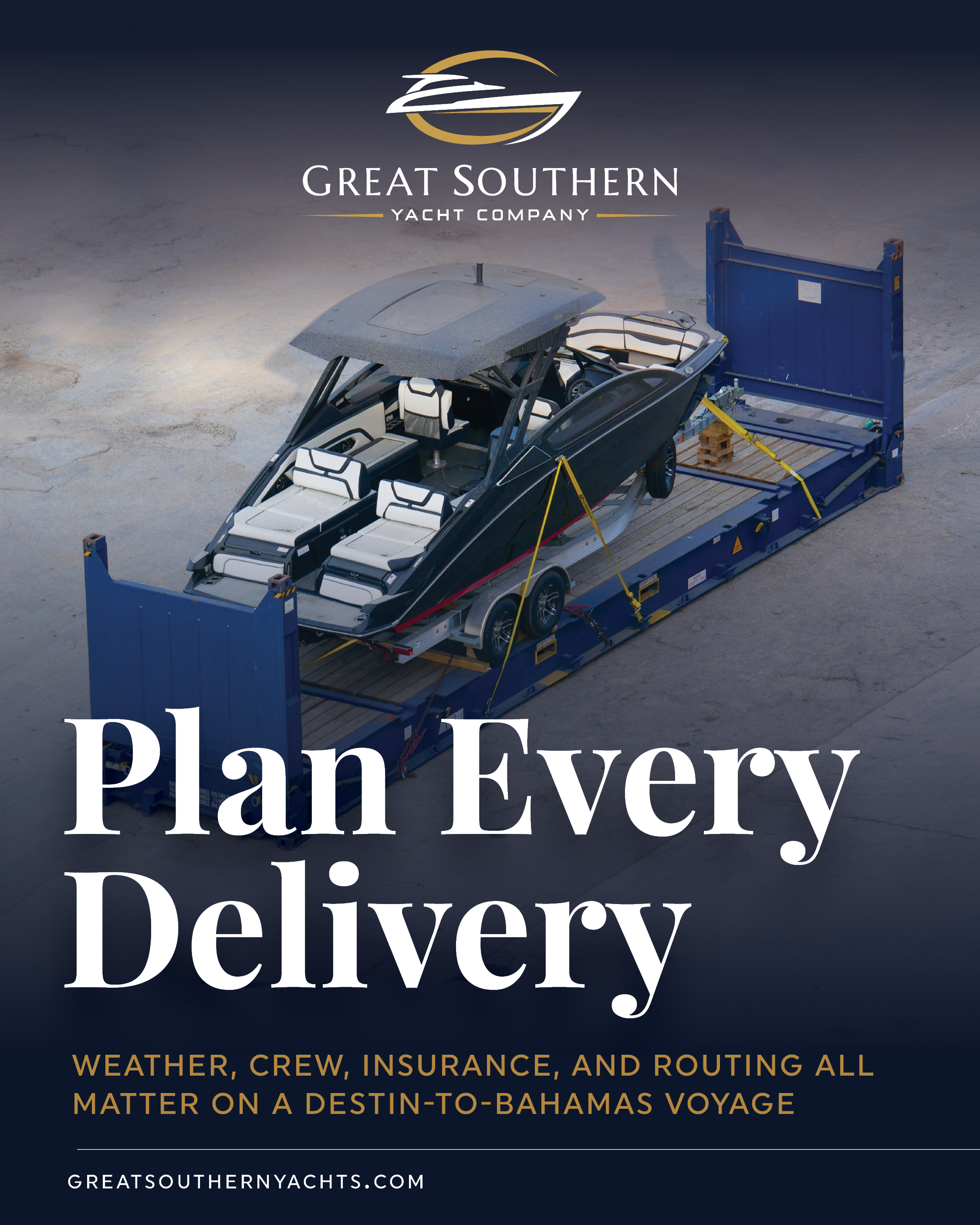
Real-world delivery planning: weather windows, crew selection, insurance binders, and contingency routing Destin to Bahamas
Real-world delivery planning: weather windows, crew selection, insurance binders, and contingency routing from Destin to the Bahamas
Moving a yacht from Florida’s Emerald Coast to the Bahamas combines open-Gulf miles, coastal transits, and a Gulf Stream crossing. Done well, it’s efficient, safe, and rewarding. Done hastily, it’s a gamble. As a fiduciary-first, brand‑agnostic Florida yacht brokerage, we approach each delivery like a private consulting engagement—balancing weather, crew, insurance, and routing so owners can proceed with confidence.
Start with seasonality and weather windows
- Winter–spring (November–April): Repeating cold fronts shape the Gulf of Mexico. Expect 3–4 day cycles: pre-frontal southerlies, frontal squalls, then a north-to-northeast shift easing over 24–48 hours. The best offshore windows often follow a frontal passage once seas subside below 3–4 feet.
- Late spring–early summer (May–June): Generally lighter winds and more predictable seas—a prime time for Gulf and Gulf Stream crossings.
- Peak summer (July–August): Calmer mornings, but strong afternoon convection. Leave early, plan shorter legs, and watch lightning risk.
- Late summer–fall (August–October): Tropical systems require conservative planning and flexible schedules.
For a Destin departure, define acceptable criteria in advance, such as sustained winds under 15 knots and seas under 3–4 feet for open-Gulf legs. Use NOAA marine forecasts, nearshore/offsore GRIBs, buoy data, and real-time observations. Before the Gulf Stream crossing (Miami/Fort Lauderdale to Bimini or West End), look for light west or variable winds; strong northerlies over the Stream create steep, dangerous seas.
Route options and contingency planning
Think in stages with Plan A/B/C built in:
-
Stage 1: Emerald Coast to the Lower Gulf
- Offshore Plan A: Destin to Clearwater/Tarpon Springs or to Naples/Marco, 24–36 hours depending on vessel speed.
- Coastal/inside Plan B: Hop ports like Panama City, Apalachicola/Carrabelle, Steinhatchee, and Clearwater, using weather pauses to reset.
-
Stage 2: Keys and South Florida
- Marathon/Key West staging offers flexibility. If offshore is closed out, the ICW from Marathon to Miami/Fort Lauderdale provides protected mileage (mind fixed bridge clearances—generally 65 feet—and opening bridge schedules).
-
Stage 3: Bahamas crossing
- Miami/Fort Lauderdale to Bimini (50–60 nm) or West End (80–90 nm). Select the entry point that suits your draft, itinerary, and clearing hours.
Contingency considerations:
- Bailout ports every 75–120 nm with confirmed fuel availability.
- Draft and air draft constraints along the ICW.
- Night navigation plan for inlets with shoaling or cross-currents.
- Fuel range with 20–30% reserve, accounting for head seas and the Stream’s set.
- Anchorages vs. marina reservations if weather stalls your schedule.
- Alternative: Overland transport for certain trawlers or sailboats when seasonal windows are constrained.
Crew selection and readiness
A capable crew is the best risk control you can buy.
- Captain/crew profile: USCG-licensed master or delivery captain with recent offshore miles, a mate experienced in night watches, and crew who understand your vessel’s systems (electrical, fuel, stabilization, electronics).
- Watchstanding: Establish a written rotation, bridge resource management practices, and standing orders for speed reductions, CPA/CPA alarms, and engine room checks.
- Safety brief: MOB procedures, ditch bag location, life raft/EPIRB/PLBs, VHF/DSC use, fire plan, and jackline/PFD protocols for night and rough conditions.
- Medical readiness: First-aid kit, seasickness meds, any crew prescriptions, and a telemedicine contact if offshore.
- Spares and tools: Racor elements, belts, impellers, fluids, hose clamps, fuses, navigation backups, and a basic electrical toolkit.
Great Southern routinely connects clients with qualified delivery captains and assembles crews suited to the yacht and route—an advantage of working with a Destin yacht broker who has real on‑water experience across the Gulf and South Florida.
Insurance binders and policy compliance
Before lines off, align the voyage with your insurance:
- Navigation limits: Confirm Gulf of Mexico offshore legs and Bahamas territories are within bounds.
- Named operators: Ensure your captain and any owner-operators are approved and listed.
- Seasonal restrictions: Some policies require a hurricane plan, tracker, or shelter location during June–November.
- Bahamas endorsement: Obtain and carry the binder showing territorial waters coverage; marinas may request proof. Add marinas as additional insureds when required.
- Commercial vs. private use: Delivery status must match your policy.
- Documentation: Keep the binder, vessel registration/documentation, and any survey requirements onboard and accessible.
We review policy language with clients and coordinate binders so there are no surprises at marinas, customs, or during any claim.
Marinas, fuel, customs, and communications
- Slippage and fuel: Reserve ahead along the Emerald Coast, Lower Gulf, Keys, and South Florida. Verify after-hours access, draft limits, and high-speed diesel availability. In the Bahamas, call ahead for fuel schedule and payment options.
- Bahamas entry: At first port of entry, obtain cruising and fishing permits, pay fees, and clear immigration. Carry passports, vessel documentation, and proof of insurance. On return, use CBP ROAM for U.S. re-entry.
- Pets and firearms: Review current regulations before departure.
- Communications: AIS, DSC VHF, cell with offshore booster, and satellite messenger or satphone for mid-Gulf legs. Redundant nav (plotter plus tablet/laptop with updated charts) and paper back-ups for key approaches.
A practical pre-departure checklist
- Weather: 72-hour and 7-day outlooks, buoy trends, Stream forecast.
- Route: Primary and secondary waypoints, inlet notes, bridge data, and bailout harbors.
- Fuel and range: Calculations with reserve; polish fuel if needed; spare filters staged.
- Systems: Engines, generators, steering, autopilot, nav lights, bilge pumps, and stabilization tested under load.
- Safety: Life raft in date, EPIRB/PLBs registered, flares current, PFDs fitted, jacklines rigged.
- Admin: Passports, vessel docs, insurance binder, towing/salvage membership, credit lines for fuel.
- People: Crew roster, qualifications, medical info, watch schedule, and roles.
How a fiduciary, private yacht consultant adds value
As a Florida yacht brokerage serving Destin, 30A, South Florida, and clients nationwide, we don’t sell you on a route—we build the right plan for your yacht, your timeline, and your risk tolerance. Our brokers regularly travel to stage vessels, join showings and sea trials, coordinate marina placement, and manage delivery logistics coast to coast. We align weather windows, crew, insurance, and contingency routing with radical transparency: everything known, everything discoverable, and everything experience suggests.
Planning a Destin-to-Bahamas run or evaluating alternatives? Talk with a Great Southern Yacht Company broker about a tailored delivery plan. We’re here to help you move with clarity.