
Yacht
Brokerage
Refined
Strategic guidance for buyers and sellers who expect more.
View All Listings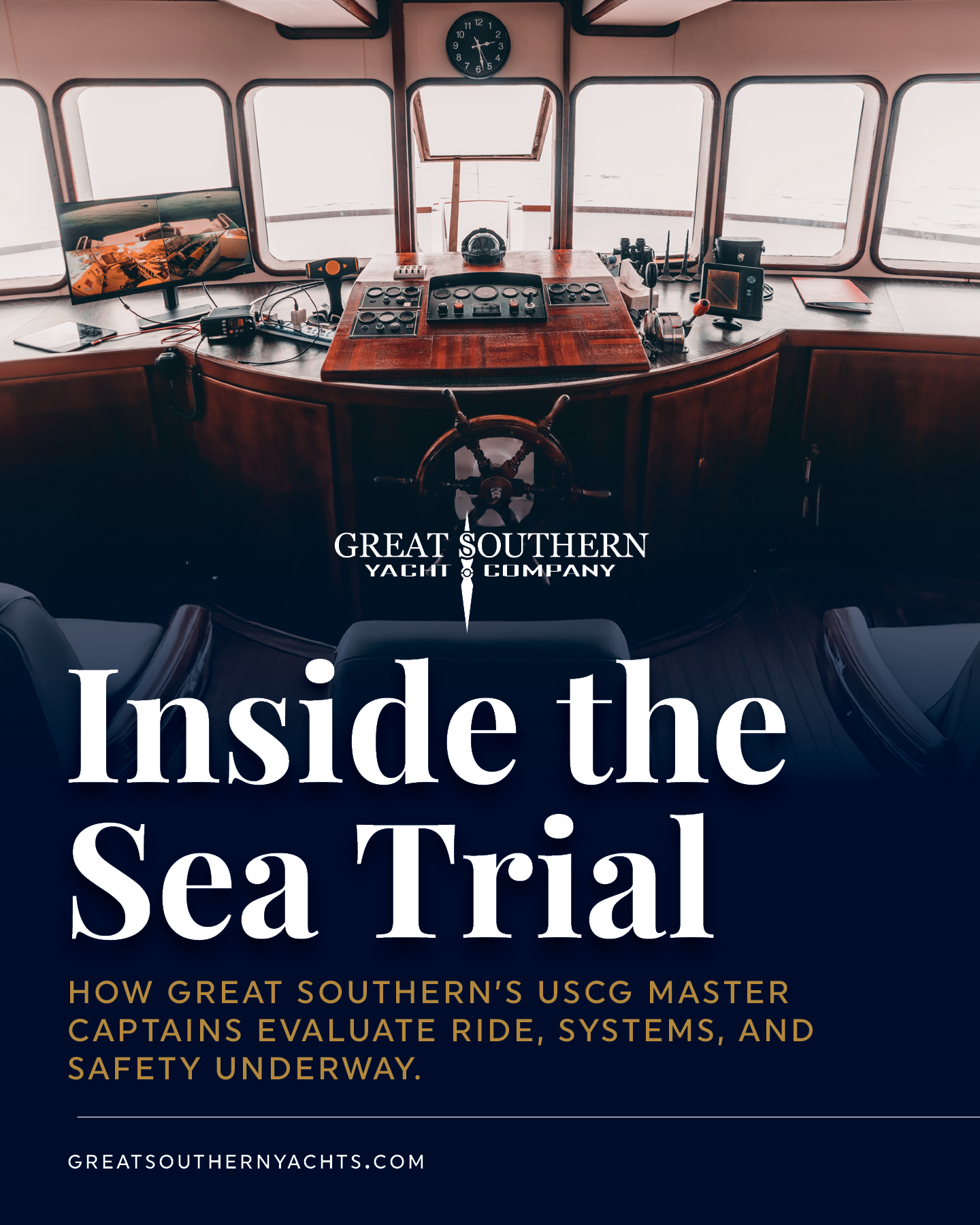
Inside a Great Southern sea trial: how our USCG Master Captains evaluate ride, systems, safety
Inside a Great Southern sea trial: how our USCG Master Captains evaluate ride, systems, safety
A sea trial is not a demo ride; it is a controlled, diagnostic evaluation designed to verify condition, confirm performance, and surface risk before you commit. At Great Southern Yacht Company, our USCG Master Captains run sea trials as fiduciary advisors—brand‑agnostic, data‑driven, and aligned solely with your interests. Here’s how we structure a professional trial for buyers and sellers across Florida’s Emerald Coast, South Florida, and nationwide.
Pre-trial planning: set the baseline
Before lines are cast, our brokers coordinate with the listing side, surveyors, and technicians to remove variables and ensure meaningful results.
- Define objectives: buyer concerns, known history, intended use (cruising, sportfishing, loop, Bahamas, offshore).
- Review records: maintenance logs, recent refits, engine hours, ABYC/USCG compliance, prior surveys.
- Capture data: pre-trial oil samples, engine ECM reports, battery tests, fluid levels, and fuel quality (vacuum readings at primaries).
- Set conditions: realistic loading (water/fuel/gear), weather and sea state, route with protected and open-water segments.
- Safety brief: PFDs, VHF checks, crew roles, engine room access protocols.
For local relevance, we plan runs that simulate your environment—Destin East Pass, Choctawhatchee Bay, 30A inlets, Intracoastal scenarios, and typical South Florida traffic patterns.
On‑water ride and handling: does the hull match the mission?
Our Captains create a repeatable profile to evaluate behavior from idle to WOT.
- Acceleration and trim: hole shot, planing time, bow attitude, effectiveness of tabs or stabilizers.
- Tracking and turns: helm response, autopilot performance, cavitation in hard turns, backing behavior.
- Speed/RPM curve: GPS speed vs. tachometer and fuel burn to confirm prop load and engine health; verify rated RPM at WOT.
- Noise and vibration: decibel readings, resonance, shaft alignment indicators, cutlass bearing and seal behavior.
- Seakeeping: head/beam/quartering seas, spray patterns, dryness of ride, stability with and without gyro/fin assist.
Underperforming WOT or excessive vibration often points to prop pitch, bottom condition, or alignment issues—items we document with specific next steps.
Propulsion and mechanical systems: trust the numbers
We test under real load and record metrics you can compare.
- Engines and gears: temperatures, oil pressure, boost, load percentage, synchronization, smooth shifting, trolling valves.
- Cooling: infrared temps at heat exchangers/manifolds, raw-water flow, strainer condition, sea chest leaks.
- Fuel system: Racor vacuum at idle and cruise, air intrusion checks, evidence of microbial growth; note filter dates and polishing history.
- Exhaust: backpressure, soot, blue/white smoke on startup and acceleration, wet/dry exhaust integrity.
- Steering and controls: hydraulic leaks, ram travel, helm play, electronic control calibration.
- Generators: load test across house systems, frequency and voltage stability, auto‑transfer and breaker integrity.
Findings are logged with photos/video and instrument screenshots for a clear audit trail during negotiations.
Electrical and electronics: redundancy and reliability
Beyond “does it power on,” we verify safe, ABYC‑aligned operation.
- DC/AC health: resting and loaded voltages, alternator output, charger/inverter function, shore‑power compatibility (30A/50A/240V), galvanic protection and bonding.
- Battery plant: age, condition, state of charge, cable terminations, thermal scan for hot connections where appropriate.
- Navigation suite: MFDs, radar tuning, AIS transmit/receive, GPS accuracy, depth calibration, VHF DSC registration and MMSI test.
- Network integrity: NMEA 2000/0183 device health and backbone power, breaker labeling, documentation.
Safety and compliance: beyond the checklist
We evaluate the whole safety ecosystem so owners can operate with confidence.
- Fire suppression: engine room fixed system service dates, manual pulls, handhelds, alarm integration.
- Bilge and alarms: pump capacity, float switch redundancy, high‑water and CO detectors.
- Ground tackle: windlass operation, breaker protection, chain/rode condition and markings, cleat backing plates.
- Emergency gear: EPIRB/PLB registration, flares and expiration, ditch bag contents.
- Ventilation: blower performance, engine room airflow, hot spot risk.
Deck, habitability, and auxiliary systems: comfort that works at sea
Liveability and mission fit are measured underway, not at the dock.
- HVAC and chillers: amp draw under load, seawater flow, condensate management.
- Plumbing: freshwater pressure, heater function, sump boxes, macerators, Y‑valves, holding tank venting, and legal overboard discharge practices.
- Heads: VacuFlush/pressure systems for leaks, cycle time, odor control.
- Stabilization and thrusters: hydraulic or electric performance, thermal load, fail‑safe modes.
- Tender and lifts: davit/winch operation, chocks, securing hardware.
For sailboats, we add rig and deck hardware inspection, sail handling, and reefing trials appropriate to conditions.
After the sea trial: clarity for decision and value
We deliver a concise, prioritized report that separates must‑fix items from advisories and preferences.
- Performance summary: ride characteristics, speed/RPM/fuel curves, WOT attainment.
- Systems status: critical findings with supporting data and estimated remedies.
- Risk and cost mapping: recommended specialists, parts sourcing, and timeline.
- Strategy: proceed, re‑trial after corrections, or renegotiate. For sellers, we guide pre‑market remedies that protect value.
Our brokers coordinate with surveyors, manage documentation, and, when needed, arrange haul‑outs, long‑distance transport, or regional deliveries. We also advise on marina and slippage—draft, beam, shore‑power compatibility, and availability—so berth planning doesn’t become a post‑closing surprise.
Why this matters to buyers and sellers
- Buyers: A disciplined sea trial protects your capital, validates mission fit, and reduces post‑closing surprises whether you plan to buy a yacht in Florida or bring one home from out of state.
- Sellers: A clean, documented trial builds buyer confidence and shortens time to close. If you’re considering “sell my yacht,” addressing sea‑trial risks proactively supports stronger pricing.
As a Destin yacht broker and 30A yacht broker with a national footprint, our Florida yacht brokerage team travels to you and acts solely as your private yacht consultant—no new‑inventory conflicts, no manufacturer obligations, just fiduciary guidance from start to finish.
Ready to evaluate a yacht—or prepare yours for market—with a professional sea trial? Contact Great Southern Yacht Company to schedule a consult with our USCG Master Captains and brokerage team.