
Yacht
Brokerage
Refined
Strategic guidance for buyers and sellers who expect more.
View All Listings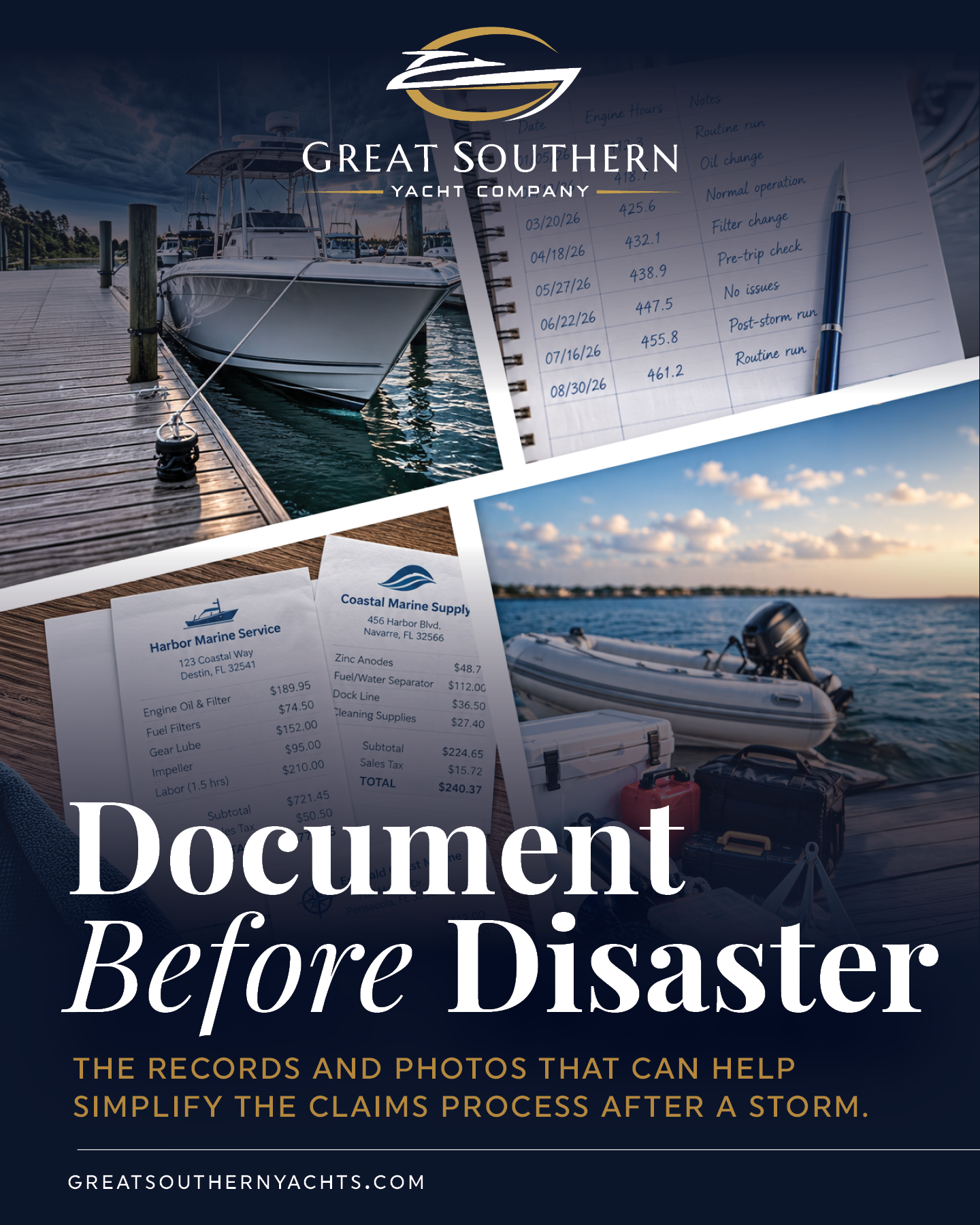
Build a concise educational post showing how to stage your records for claims: pre-storm photo set, engine hours log, maintenance receipts, and current inventory list for loose gear and tender
How To Prepare Your Yacht Records For Storm-Related Insurance Claims
When a major storm hits the Gulf Coast or South Florida, the strength of your insurance claim often comes down to one thing: documentation. Having your yacht records staged and organized before hurricane season is one of the most effective ways to protect your investment and shorten the path from incident to settlement.
This guide walks through a practical system any yacht owner can follow:
- a pre-storm photo set,
- an engine hours log,
- maintenance records, and
- a current inventory list for loose gear and tenders.
Whether you work with a Destin yacht broker, a 30A yacht broker, or a national yacht consultant, these steps will help you navigate storm-related claims with clarity and confidence.
1. Build a Pre-Storm Photo Set
Insurance adjusters need to understand the yacht’s condition before the storm. A well-organized pre-storm photo set can make the difference between a smooth claim and a prolonged dispute.
What to photograph
Create a folder labeled with the date (for example, “Pre-Storm Condition – June 2026”) and capture:
Exterior:
- Bow, stern, port, and starboard full-profile shots
- Close-ups of hull sides, boot stripe, and bottom paint (if hauled)
- Deck, railings, pulpit, cleats, windlass, and anchor system
- Hardtop/soft top, outriggers, antennas, radar, domes, and solar panels
- Windows, hatches, and all canvas or isinglass
Interior:
- Salon, galley, cabins, and heads (wide shots and key details)
- Helm stations, control panels, electronics, and navigation equipment
- Engine room and machinery spaces, including engines and generators
Systems and details:
- Batteries and chargers, electrical panels, shore power connection
- Air conditioning units, pumps, and key mechanical components
- Tender and outboards, including HIN/VIN and serial numbers where visible
How often to update
- Annually before hurricane season (or when moving to a higher-risk region)
- After any major refit or upgrade (electronics, engines, paint, interior)
- After relocating marinas or changing storage (dry stack vs. in-water)
Store photos in at least two places: a cloud folder (Google Drive, Dropbox, etc.) and on a portable drive you keep at home or in a safe.
2. Keep an Accurate Engine Hours Log
Adjusters and surveyors often look to engine and generator hours as an indicator of usage, maintenance needs, and potential pre-existing issues.
What your log should include
Set up a simple table in a spreadsheet, notebook, or vessel logbook with:
- Date
- Engine hours (port/starboard)
- Generator hours
- Location (marina, anchorage, yard)
- Notes (short run, long passage, sea trial, post-service run, etc.)
Example entry:
- 06/05/2026 – Port: 820 hrs, Stbd: 816 hrs, Gen: 410 hrs – Destin, FL – Returned to slip post-service run, all temps/pressures normal.
Why this matters for storm claims
If engines or generators are damaged during a storm (flooding, submersion, impact), an hours log helps establish:
- Pre-storm operating condition
- Consistent use and warm-up patterns
- Correlation with maintenance entries (oil changes, services, etc.)
This can support your position if there’s any question about whether damage is storm-related or due to prior condition.
3. Organize Maintenance Receipts and Service History
A clean, well-documented maintenance file is one of the strongest tools you have in any insurance or resale discussion. For yacht owners on the Emerald Coast or in South Florida, where storms are part of life, it becomes especially important.
Core documents to keep
- Engine and generator service (oil changes, coolers, impellers, belts, filters)
- Drive train and running gear (shafts, props, seals, rudders, thrusters)
- Electrical and electronics work (panels, wiring, navigation systems, radar)
- Hull, paint, and gelcoat work (including bottom jobs and blister repair)
- Canvas, upholstery, and structural repairs
- Haul-out invoices and yard reports
Whenever possible, retain both:
- The invoice or work order, and
- Any survey, yard report, or technician notes that describe findings.
How to structure your records
Create a main folder for the vessel using her official name and HIN, then subfolders such as:
- 01 – Surveys & Appraisals
- 02 – Engines & Generators
- 03 – Electrical & Electronics
- 04 – Hull & Running Gear
- 05 – Interior & Canvas
- 06 – Insurance & Policy Docs
Scan paper receipts to PDF and save them in the relevant folder. If you sell your yacht or work with a Florida yacht brokerage later, this organization can also support a higher level of buyer confidence.
4. Maintain a Current Inventory List for Loose Gear and Tender
Loose gear and tenders are frequently damaged or lost in storms. Having a clear, dated list helps demonstrate what was onboard and its value.
What to include in your inventory
Create a spreadsheet with the following fields:
- Item (e.g., 10’ RIB tender, 15hp outboard, life raft, EPIRB)
- Brand/model
- Serial number or HIN (where applicable)
- Estimated replacement value
- Purchase date and retailer (if known)
- Location on board (flybridge, lazarette, engine room, etc.)
Break it into logical sections:
- Safety gear (life jackets, rafts, flares, EPIRBs, grab bags)
- Navigation/electronics (portable GPS, handheld VHF, tablets, laptops)
- Fishing gear (rods, reels, tackle systems)
- Water toys (SUPs, kayaks, inflatables, dive gear)
- Tender and outboards (with photos and serials)
Attach corresponding photos of high-value items and, where available, purchase receipts or order confirmations.
Special attention to your tender
For many owners, the tender is effectively a second vessel. Document:
- HIN and registration
- Engine make, model, and serial number
- Trailer VIN (if applicable)
- Accessories (GPS, VHF, console electronics, covers, davits, chocks)
Storms often separate tenders from motherships; having this documentation ready streamlines any stand‑alone tender claim.
Putting It All Together Before Storm Season
To stage your records for claims, aim to have the following complete and accessible:
- Dated pre-storm photo set of the yacht, tender, and key systems
- Up-to-date engine and generator hours log
- Organized maintenance and service records
- Detailed inventory of loose gear and tender equipment
- Copies of insurance policies, including endorsements and storm‑related requirements
Review everything annually with your insurance professional and, if you work with a private yacht consultant or Florida yacht brokerage, ask them to spot any gaps from a buyer or surveyor’s perspective.
If you’d like guidance tailoring this documentation system to your specific yacht, cruising plans, or marina situation on the Emerald Coast or in South Florida, Great Southern Yacht Company is here to help. Contact our team of professional yacht consultants to discuss your vessel, your plans, and the best way to protect your investment long before the next storm appears on the radar.